Image Credit: Wikimedia Commons
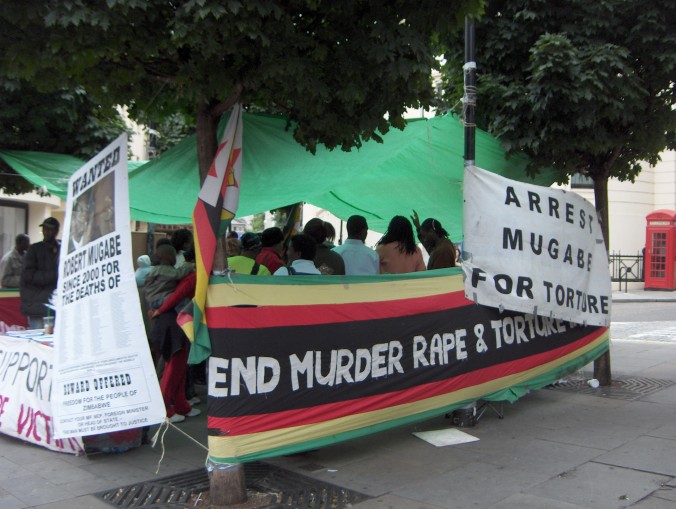
On 15 September 2008 the Global Political Agreement (GPA) forming a Unity government in Zimbabwe was signed. It was signed between Zimbabwe African Union-Patriotic Front (ZANU-PF) and the two Movement for Democratic Change (MDC) formations.
One of the commitments in the GPA was to produce an autochthonous constitution. Article VI of the GPA provides in part that the new Constitution should “deepen [sic] our democratic values and principles and the protection of all citizens…” To that end a Select Committee of Parliament (COPAC) was established and tasked with co-ordinating the drafting of the new constitution.
Three and a half years behind schedule, COPAC produced a draft constitution which was received with overwhelming support by those who voted in the 16 March 2013 referendum. Thereafter, the constitution was gazetted as the Constitution of Zimbabwe Amendment (No 20) and having been adopted by both the National Assembly and the Senate, it was signed into law by the President on 22 May 2013.
However, the constitution was not wholly operational since it distinguishes between the “publication date” and the “effective date”. The publication date refers to the time the constitution is published in a Gazette while the effective date means the day when the first president elected under the new constitution is sworn in and assumes office (cf: Sixth Schedule).
Granted that the President-elect was sworn in on 22 August 2013 meaning that the Constitution of Zimbabwe Amendment (No 20) is now wholly operational, the question, which is now preoccupying Zimbabweans as well as the regional and international community, is does the new constitution embody constitutionalism? In a series of articles this question will be interrogated.
Constitutionalism has been said to ‘encompass the idea that a government should not only be sufficiently limited in a way that protects its citizens from arbitrary rule but also that such a government should be able to operate efficiently and in a way that it can be effectively compelled to operate within its constitutional limitations’ (cf: Charles Fombad (2008)). Thus, constitutionalism stems from the appreciation that men govern over men, and such ‘men are not angels’ as such there is a need to create controls on the power of those who govern while simultaneously ensuring that the government does not become handicapped.
Forming the bedrock of constitutionalism is a number of fundamental tenets. These tenets include, among other things: a supreme constitution, fundamental human rights, separation of powers, an independent judiciary vested with powers to review the constitutionality of laws, the existence of provisions controlling the amendment of the constitution, and the establishment of institutions that promote a constitutional democracy. Therefore, in order to ascertain whether the new constitution of Zimbabwe embodies the doctrine of constitutionalism, the constitution will be analysed against the above-mentioned tenets of constitutionalism.
This part looks at the doctrine of separation of powers focusing on the President vis-á-vis the Legislature.
Charles Louis de Secondat Baron de Montesquieu has been celebrated as an exponent of the doctrine of separation of powers. In his seminal work, The Spirit of Laws, Montesquieu propounded that government has to be separated into three different arms, namely executive, legislature and the judiciary. He further advocated that ‘power should check power’. In other words, he was contending for what the Americans have called “checks and balances”, or as Madison would put it, “auxiliary precautions”.
The constitution of Zimbabwe declares itself to be the Grundnorm of the land with every law, practice, custom or conduct having to be consistent with it (cf: S 2).
Section 3 lists nine foundational values forming the bedrock of the constitutional order (cf: s 3). One of the founding values is the doctrine of separation of powers. This is plausible because it curbs excesses in government since as Lord Acton noted ‘all power tends to corrupt and absolute power corrupts absolutely’.
Testament to the fact that it captures the separation of powers, the constitution mandates that all institutions account to parliament, and cabinet members must attend parliament and parliamentary committees to respond to questions. However, in the wake of one political party having garnered the majority of seats in parliament and political party elitism is it doubtful whether this mechanism will be useful in ensuring that the legislature does not degenerate into a subcommittee of the executive branch of government.
Unlike the now extant Lancaster Constitution which empowered the President to fix sessions of parliament, the new constitution provides that parliament determines the time and duration of its sittings (cf: s146). Further, the President no longer wields the power to frustrate the law making process since it is now peremptory for him/her to assent to a Bill (cf: s131).
Whether this is a significant achievement towards the independence of the Legislature is debatable. One must considere the fact that in most cases Bills are introduced by cabinet members after such bills have been discussed in cabinet meetings chaired by the President. Further, the political party whips ensure that the Bill sail through the parliament without much hindrance.
Unfortunately, section 116 is likely to operate as a claw-back as it states that the President is part of the Legislature. This is incompatible with the doctrine of separation of powers, and undermines the doctrine. It is feared that this anomalous section is likely to render the provisions of the Presidential Powers (Temporary Measures) Act (Chapter 10:20) constitutional.
In terms of the Temporary Measures Act the President is empowered to make Regulations which “may provide for any matter or thing for which Parliament can make provision in an Act”. This legislation has been criticised for allowing the President to rule by decree. It was recently used to proclaim 31 July 2013 as the Election Day and to amend the Electoral laws of the country while parliament was in session.
The constitution allows the President to encroach into the terrain of the legislature in that he appoints two Ministers to the important Parliamentary Standing Rules and Order Committee in addition to the Minister of Finance who is ex officio part of the Committee (recall that the Minister of Finance is appointed by the President) (cf: s151(2)(c)).
The constitution provides for the removal of the President through a process of impeachment (cf: s 97). Whether such removal is likely to result in a major policy shift in the government is doubtful since the Vice President from the political party of the removed President assumes the reins when the President is impeached (cf: s101).
In my view, a better approach would be one whereby the country goes for a general election. In terms of section 109, the government is removed through Cabinet members by a motion of no confidence, which is passed by the Senate and the National Assembly.
Two shortcomings are identifiable in section 109. First, the threshold required for such a resolution to be passed is too high, viz. two-thirds majority. Secondly, since the president has an option to dissolve parliament when such a resolution is passed, the threat of dissolution is like a Sword of Damocles hanging over the heads of parliamentarians frustrating them from bringing the executive arm of government to account.
Comments
Share On