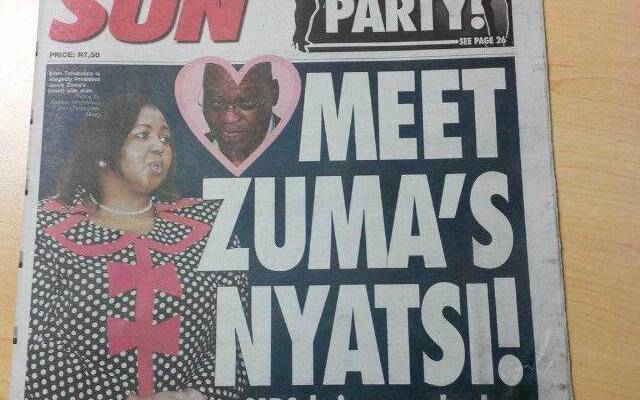
On 16 November 2014 the Sunday Sun ran cringe worthy front page. “MEET ZUMA’S NYATSI” reads the headline in caps. “SABC chairwoman by day, President’s pet by night”.
The story is about South African Broadcasting Corporation chairwoman Ellen Tshabalala. The journalists, Prince Chauke and Norman Masungwini, produce a tabloid-style tirade of unsubstantiated allegations. Relying on anonymous sources, they allege that Tshabalala is having an affair with the President.
The allegations are the least noteworthy bit of their TMZ-style report. Look instead at the language.
They boldly call Tshabalala a “nyatsi”. The term “nyatsi” is a Sesotho equivalent of “concubine”. In context, the term carries deeply offensive connotations applicable exclusively to women. “Nyatsi” is used to refer only to women. There isn’t an equivalent for men.
The paper goes on to call Tshabalala the “President’s pet”. This is the epitome of misogyny and patriarchy—dehumanizing women by comparing them to animals.
I am certain that, like many humans, Tshabalala has flaws. Moreover, the paper is has a constitutional right to report allegations of corruption and abuse of power in government. But, a question worth asking is whether this gives the paper license to be sexist and intentionally abusive.
Section 16 of the Constitution provides that, ‘Everyone has the right to freedom of expression, which includes freedom of the press and other media’. Section 16(2) provides that ‘freedom of expression’ does not extend to ‘advocacy of hatred that is based on… gender’.
Calling Tshabalala a “nyatsi” and a “pet” serves no journalistic purpose. It harms not just Tshabalala, but also the constitutional imperative of gender equality.
In a country battling a systemic scourge of gender-based violence, sometimes dubbed the rape capital of the world, it is not surprising that two male journalists think they have license to call a woman a pet.
It is easy to ignore offensive language that is associated with President Zuma because he is an easy target. However, the sexist and misogynistic language used by the journalists falls outside the constitutionally protected bounds of free press. It serves only patriarchy, and it is unconstitutional.
Comments
Share On